Let’s face it. Most new construction projects look more like a mess than a plan. You’re not Bob the Builder. You’re more like Sun Tzu with a blueprint.
Your first step should be to plan in your mind, not with materials. This is the key principle. It’s like the Pre-Embark phase in Dwarf Fortress. You must decide on your strategy: diplomacy, minimalist survival, or stranded scout squad.
This choice will shape everything that comes next. It’s like the law in Brazilian Jiu-Jitsu: positional wealth comes before submission. A white belt must control the mount before going for an armbar. A rookie builder must control the vertical plane before trying fancy edits.
Your main tool is your plan. Your strongest defense is your structure.
We follow a tiered approach: Rookie, Grinder, Champion. The foundation is knowing your build is your game plan. This is true whether you’re building a digital fortress or aiming for real-world strength through fortified standards.
Don’t focus on winning the fight. First, you must win the land it’s on. That’s where building tips truly start.
Speed Building Drills
Strategy is like a blueprint, but speed building is the frantic effort to complete it before time runs out. It’s the moment when theory meets action, filled with sweat and a racing heart. You can admire a design all day, but can you build it while being rushed?
Think like a Brazilian Jiu-Jitsu practitioner. They don’t just learn an escape; they practice it until it’s automatic. The mat is a place for muscle memory. Your building game needs the same focus and practice. The goal is to build necessary, not just pretty.
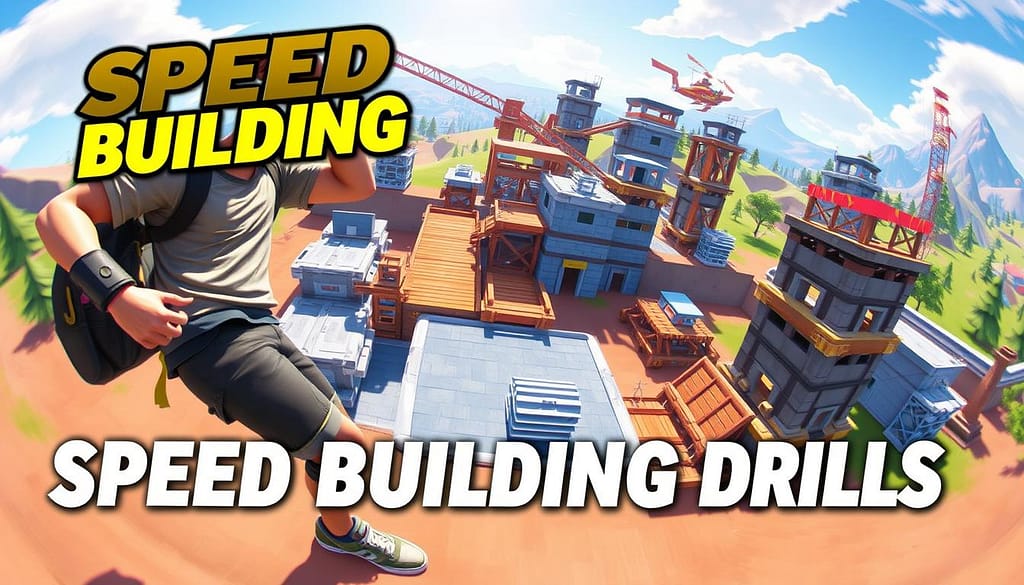
Consider Project Zomboid’s “Quick-Start” guide. In this survival game, your materials and skills are everything. Your keybinds are your tools, and your skill level is your fluency with them. Ask yourself: What are my essential materials? Is my ‘Carpentry Level’ high enough to build under pressure?
Deliberate practice is key. Create your own “Stranded Scout Squad” scenarios in creative mode. Simulate being short on resources. Challenge yourself to build a box in 15 seconds or retake high ground with only 50 wood. This isn’t just building; it’s testing your skills under fire.
Top players don’t just build structures. They link them together smoothly. A wall is a noun, a ramp is a verb, and an edit is the punctuation that changes everything. Mastering this is what makes a builder fast. Your edits should flow like a comma changes a sentence.
The practice can be tough. But it’s like an athlete perfecting their form. Just as a runner uses essential run drills for speed, you are honing your foundational moves. The repetition is worth it for automation.
To improve, break down your training. What are you actually practicing? The table below shows different drills and their focuses, helping you find your weaknesses.
| Drill Type | Primary Focus | Practice Scenario | Key Metric | Mental Model |
|---|---|---|---|---|
| Keybind Fluency | Muscle Memory for Wall/Ramp/Floor | Creative Mode, Unlimited Mats | Actions Per Minute (APM) | Typing Without Looking |
| Defensive Boxing | Speed & Placement Accuracy | “Stranded Scout” (Low Mats) | Time to Complete Box (sec) | BJJ Escape Drill |
| Edit Pathway Drills | Clean Edit Plays & Resets | Edit Courses (Pre-built Mazes) | Success Rate (%) | Grammar & Punctuation |
| High-Ground Retake | Sequential Structure Chaining | 1v1 Retake Scenario | Fluidity (Subjective Score 1-10) | Building a Sentence |
| Material-Scarce Builds | Efficiency & Improvisation | 50 Wood Challenge | Structures Built per 10 Wood | Project Zomboid Survival |
Notice how each drill focuses on a specific skill. You wouldn’t practice boxing by only fighting. You’d work on footwork, then head movement, then combinations. Isolate to integrate. The Dwarf Fortress miner doesn’t learn to dig while being chased. They master the pickaxe swing first.
The goal is to make your defensive box and offensive retake automatic. When pressure mounts, your hands should move without thinking. Your edit plays become a reflex. That’s when you’ve truly built speed. You’ve turned the architect’s plan into action.
Offensive and Defensive Plays
Think of your fortifications as a chessboard, not a castle keep. It’s a trap for your opponent’s king. Your materials are not just for building; they are for feints, traps, and psychological games. We’re moving from just building walls to using them as part of a bigger strategy.
Let’s talk about defense, inspired by Project Zomboid survivors. They use smart barriers to survive. Here’s how you can apply their ideas:
- Double Wall Layers: One wall is a hint. Two is a clear message. It gives you time to heal, reload, or move when the first wall falls.
- Choke Points: Don’t defend a wide area. Use a narrow space where your shotgun works best and your enemy can’t move much.
- The Safehouse Upstairs: Control the only staircase. This way, you control the fight. It’s hard to get to you, making your enemy vulnerable.
- Use Existing Structures: Reinforce a door instead of building a new wall. It saves time and resources for your next move.
Every wall has its own strengths and weaknesses. Wooden walls are fast but don’t last long. Metal walls are strong but take time to set up. Your choice is your first move.
But why just defend? Take a page from Dwarf Fortress and make your fortress a power base. It’s not just for hiding; it’s for showing dominance. This is the offensive side of fortification.
How do you do this? Think like a Brazilian Jiu-Jitsu master. A BJJ move flows into another, like an armbar to a triangle choke. This is similar to how you edit your walls and then attack.
This leads to the Adaptation Principle. If your enemy just shoots at your walls, trick them. Build a fake stairwell and let them waste ammo. If they hide in a box, attack them from inside. Use smart builds and edits to get close to them.
Choosing materials becomes a tactical decision, not just for looks. When is it better to choose durability over speed? Let’s look at it.
| Material | Build Speed | Effective HP | Best Tactical Use Case |
|---|---|---|---|
| Wood | Very Fast | Low | Quick decoys, rapid re-routing, bait structures. |
| Brick | Medium | Medium | Primary choke point walls, mid-fight cover. |
| Metal | Slow | Very High | Final safehouse walls, unbreakable high-ground floors. |
The goal is to make your fortress grow and shrink. It should expand to take new land and contract to trap enemies. Your builds are your army, and you are the commander. Now, lead them.
Examples from Top Builders
So, you’ve studied the blueprints of the greats. Think of the Dwemer City-State planner, the Mad Butcher, and the Venetian. Their genius isn’t just speed. It’s a philosophy of building a system that’s so strong, attacking it is a mistake.
This is the highest form of fortification. It’s not just about thicker walls. It’s about a structure where recovery is easy and your opponent’s advance is a trap.
Consider the real-world IBHS FORTIFIED program. It’s not about adding more materials. It’s a systematic approach where every part works together as a defense. The data shows it’s a smart investment.
For a top builder, every wall piece and ramp is part of a bigger system. Your journey is similar. The Rookie learns the basics. The Grinder focuses on chains. The Champion is a true master.
You don’t copy others. You learn from them and create your own. Your building becomes your unique signature, your unshakeable fortification.
The final lesson? Build a strong foundation. Make your position so strong that the fight is on your terms, in your fortress. That’s how you win.