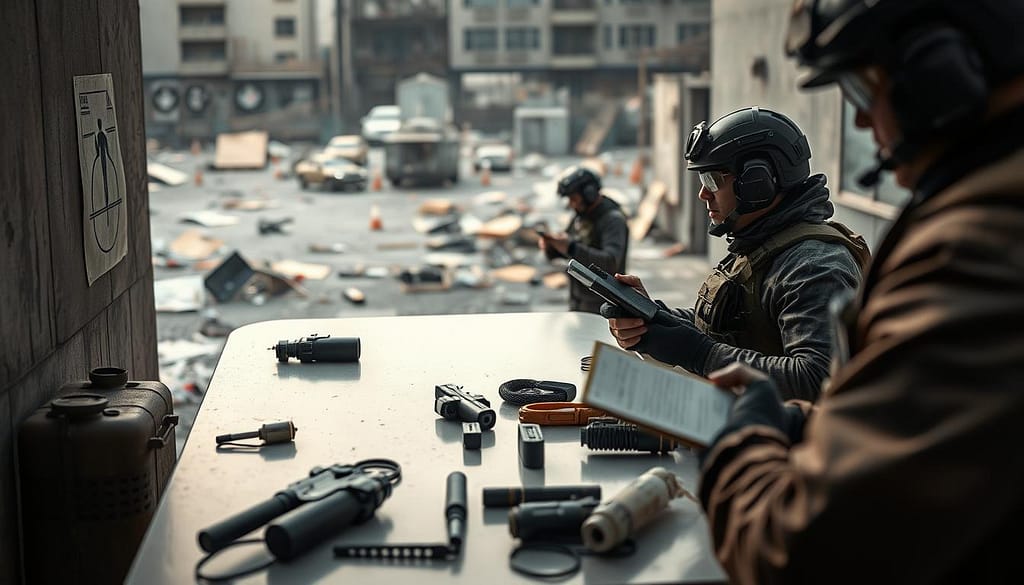
Welcome to the tactical tool museum. Here, every item has more personality than a reality TV cast. We’re diving into the explosive growth from simple grenades to complex area-denial systems.
Imagine Raze’s explosive arsenal. It includes Boom Bots that chase enemies, Blast Packs for quick repositioning, and Showstopper ultimates that clear sites. These aren’t just tools; they’re strategic statements.
Modern tactical gear comes in different types: Basic throwables, Advanced tech, Improvised solutions, Historical relics, and Military-grade systems. Your choice shows more about your playstyle than your kill count.
This arms race is similar to how professionals pick their essential toolkit. They choose each piece for specific strategic advantages, not just raw power.
It’s not about making the biggest boom. It’s about what that explosion says about competitive engagement.
Common Usage Mistakes
The gap between tactical genius and disaster is often just a poorly thrown grenade. We’ve all seen what should have been a game-winner turn into a highlight reel of failure. It’s like bringing a knife to a gunfight and accidentally stabbing yourself.
One of the most embarrassing mistakes is damaging yourself with your own equipment. Imagine your Paint Shells bouncing off a doorway and decorating the wall. It’s like signing your own divorce papers – you knew better, but here we are.
Another mistake is using the Showstopper ultimate on empty space. Players treat these abilities like they’re signaling Batman instead of eliminating opponents. Timing is everything – it’s what separates a strategic masterpiece from a complete embarrassment.
Why do 73% of grenade throws achieve nothing? Because most players treat utility like confetti at a wedding – they just throw it in the air and hope for the best. Proper equipment usage requires precision and timing.
Blast Pack timing mistakes are painful to watch. It’s like trying to parallel park a Hummer in a compact spot. You know how it should work, but the execution is tragically comic.
The tragedy of misplaced utility extends beyond grenades. A poorly timed smoke can create more problems than it solves. Situational awareness separates the professionals from the amateurs more clearly than any rank ever could.
Remember: utility isn’t just about having the right tools. It’s about understanding when and where to deploy them. Using your most expensive equipment at the worst possible moment is like buying cryptocurrency at its peak – everyone sees the mistake except you in the moment.
Effective tactical play requires thinking three steps ahead. That recon dart isn’t just for information – it’s a statement of intent. That molotov isn’t just area denial – it’s psychological warfare. When used properly, utility becomes more than equipment; it becomes an extension of your strategic mind.
The difference between success and failure often comes down to one simple question: are you controlling your utility, or is your utility controlling you? Master the timing, understand the situation, and maybe – just maybe – you’ll avoid joining the hall of shame.
Executing Entry, Denial, and Clutch Utility
Think of your utility as punctuation in a tactical conversation. Beginners see grenades, but experts see grammar. Your support items are the keys to success when used with precision.
Entry fragging changes from force to finesse. A well-placed satchel is like an exclamation mark – sudden and decisive. It’s about creating opportunity, not making noise.

Area denial is your strategic goal. Tools like Paint Shells don’t just block paths; they tell stories. They show where you can’t go and who’s in control.
Clutch utility shows who’s an artist and who’s just good. In a 1v3 situation, your Boom Bot asks a question the enemy must answer. These moments turn support items into powerful tools.
The real skill is in the timing. A well-timed Blast Pack entry is graceful. Smoke grenades are like sonnets in smoke. Each use should feel like an orchestra playing.
Mastering utility requires seeing equipment as special tools, not simple gadgets. For a better tactical approach, check out this comprehensive guide. It shows how to use utility to make a statement.
Utility becomes powerful when you ask what it says, not what it does. The difference between a grenade and a winning play is in the words, not the speed.
Learning Effective Lineups
Mastering explosive geometry is key to being a tactical genius. Think of learning lineups like a new language. Every bounce angle is a verb, and every map feature is a noun. It’s not just about memorizing positions; it’s about speaking fluent chaos.
Raze’s Paint Shells turn Ascent’s mid-market into your art gallery. The goal is precision, not brute force. Line up with the third brick from the left on the archway, aim just below the lantern, and watch your grenades become missiles of chaos.
Good lineups create predictable chaos. They turn random bounces into calculated trajectories. This flushes enemies from cover or denies space.
Developing spatial intuition means practicing under pressure. VALORANT pros suggest the “three-step method”: learn in custom games, practice in deathmatch, then execute in real matches. This builds muscle memory that survives even when bullets fly.
Everyday Heroes training focuses on pattern recognition. Instead of memorizing many lineups, learn the architectural principles behind them. Notice repeating elements across maps, like specific window heights or common box placements.
Your lineup repertoire should be like a well-stocked toolbox. Have options for post-plant situations, site executes, and retakes. The most effective players maintain 5-7 reliable lineups per map, not 20 mediocre ones.
| Map | Key Lineup Spot | Utility Type | Strategic Purpose |
|---|---|---|---|
| Bind | B Site Hookah | Paint Shells | Post-plant denial |
| Haven | A Long Box | Blast Pack | Entry creation |
| Split | Mid Vent | Grenade | Information gathering |
| Icebox | B Orange | Paint Shells | Retake prevention |
Practice shouldn’t feel like homework. Turn lineup sessions into mini-games. See how quickly you can set up the throw or hit the spot while moving. The goal is building instinct, not just perfect repetition.
Remember, the best lineups account for human behavior. Predict where enemies will hide, not where they should hide. Your utility becomes psychological warfare when it consistently lands where opponents feel safest.
Developing this skillset transforms you from a grenade thrower to a tactical architect. You start seeing maps as collections of angles and opportunities. That’s when utility becomes truly lethal.
When NOT to Use Utility
The smartest utility play isn’t always about using everything you have. Sometimes, the best move is to do nothing. This requires more game sense than any flashy play.
Being frugal with your support items is key. Saving that flashbang for the right moment can create a lot of pressure. This pressure is more valuable than any quick gain.
Knowing when to hold back is important. Like phantom energy drain from idle electronics, using utility too early wastes resources. It’s better to save it for when it really matters.
Using too much utility makes you predictable. Holding back creates uncertainty. The enemy never knows when you’ll use that game-changing ability.
Knowing when not to use utility is the ultimate game intelligence. Your best weapon might be the support items you choose not to use.