In Rocket League, every second is key. Dreaz, a pro from Dignitas, says even top players warm up before games. They spend 15 minutes in Free Play before scrims and 40 minutes before official matches. This gets their eyes and hands ready to perform at their best.
Why is this important? Training eyes and hands is vital. Players need to track the ball fast, spot small bounces, and read opponents quickly. They also need to control the controller precisely. Without warming up, players might only use 60-70% of their skills in ranked matches.
Having a structured warm-up routine boosts performance. It’s not just about spending time; it’s an investment in being your best. The aim is to quickly reach over 95% of your peak ability for the first game. A good warm-up is something you can repeat, measure, and adjust, setting a strong base for every game.
Want to improve your warm-up? Check out this core warm-up framework. It focuses on effective practice and time management.
3‑Block Routine (tracking, flicks, reaction)
Get ready to shine on the field with the 3-Block Routine. It’s a quick 10-minute warm-up that boosts your skills. Each part focuses on different skills to improve your game.
Block One — Tracking is all about chasing the ball in Free Play for three minutes. You’re not trying to score, but to follow the ball’s path. This helps you guess where the ball will go next.
Block Two — Flicks is about making precise shots. Use the Ground Shots training pack or Free Play to practice. You’ll work on side-flip shots, diagonal chips, and hook shots. The goal is to hit your target every time.
Block Three — Reaction is for your defense. Use the Saves pack or Free Play to practice quick saves. You’ll learn to react fast to unexpected shots. This improves your speed and accuracy in defense.
| Block | Focus Area | Training Pack | Duration |
|---|---|---|---|
| Block One | Tracking | Free Play | 3 minutes |
| Block Two | Flicks | Ground Shots | 3 minutes |
| Block Three | Reaction | Saves | 4 minutes |
This routine is a complete cycle: track, flick, and react. It’s done in under 10 minutes. It gets you ready for the game and mental preparation.
Map‑Specific Angle Reps
To excel in competitive play, focusing on map-specific angles is key. Each competitive map has unique geometry that affects ball interaction. Understanding these angles boosts your gameplay.
Free Play is great for practicing these angles. It lets players explore and master each map’s details. Dreaz, a top player, uses Free Play to improve his skills before matches. This way, he’s ready for any match scenario.
For effective practice, spend 4 minutes on the map you’ll play. Load Free Play on that map. Then, work through five key angle families:
- Corner Bounces: Focus on how the ball exits the curved corner ramp.
- Backboard Rebounds: Track the ball off the back wall at various speeds and heights.
- Side-Wall Clears: Practice defensive touches that redirect the ball safely into the opponent’s half.
- Ceiling Deflections: Read balls that strike the ceiling and drop vertically.
- Cross-Bar Dinks: Predict how shots that strike the crossbar will carom.
The Aerial Shots – Redirects training pack (8D93-C997-0ACD-8416) has over 40 scenarios. It simulates in-game angle reads. This aim routine builds a mental library of trajectory patterns. When you see these angles in a match, your brain knows the right response.
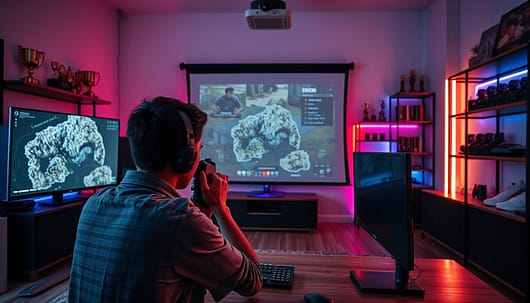
Mental Switch‑On Ritual
A good mental switch-on ritual can really boost your game. It acts as a bridge, moving you from getting ready to playing your best. While training your body helps, the mental ritual is key to performing well under pressure.
To change your mindset, follow a three-step process that takes only three minutes:
- Slow-Motion Free Play: Begin with 90 seconds in slow-motion mode, set at 50% speed. This method, used by pro player Dreaz, helps your brain adjust to slower inputs. When you switch back to normal speed, everything seems faster, improving your reaction times.
- Casual Match Simulation: Play a Casual match, but treat it like a serious game. Focus on your gameplay, including rotations and communication if playing with others. This practice gets your brain ready for ranked play without the stress of losing rank.
- Box-Breathing Exercise: Finish with a 30-second box-breathing exercise. Breathe in for four seconds, hold for four, breathe out for four, and hold again for four. This calms your heart rate and cortisol levels, getting you ready for ranked play.
By adding these steps to your pre-game routine, you’re not just physically ready. You’re also mentally focused. Your reaction times will be better, and you’ll be emotionally prepared for competitive play.
| Step | Description | Benefits |
|---|---|---|
| 1 | Slow-Motion Free Play | Enhances visual processing and reaction times |
| 2 | Casual Match Simulation | Activates neural circuits without performance anxiety |
| 3 | Box-Breathing Exercise | Regulates heart rate and reduces stress |

Logging Performance & Adjusting Daily
Effective warm-ups are more than just repeating exercises. They need a personalized touch that changes as you get better. Keeping a log of your practice helps turn warm-ups into a key tool for growth. By tracking warm-up blocks, how ready you feel, and your first game results, you spot patterns that affect your play.
For example, if you find that more micro-flicks practice improves your first game accuracy, adjust your routine. This method lets you focus on what works for you, making each warm-up meaningful. It’s about improving your strategy, not just doing the same thing every time.
Things like sleep and the time of day also matter for your performance. Tracking these factors with your warm-up results gives you deeper insights. This helps you see how different conditions impact your game, allowing for small but important improvements.
The 15-minute Warm-Up System is flexible and changes with your needs, no matter the season. Players who log, review, and tweak their routines regularly do better than those who don’t. By adopting this flexible approach, you’re set for success in ranked games and scrims.