In great films, what you hear is as important as what you see. The sudden silence after an explosion in Saving Private Ryan feels intense. A soft whisper in Joker is scarier than a loud shout.
This power isn’t magic. It’s intentional sound design based on clear rules. This is shown by experts talking about how clarity beats complexity.
In competitive gaming, sharp hearing isn’t magical. It’s a skill you can learn. It’s about understanding the game’s audio engine.
Modern tech uses HRTF (Head-Related Transfer Function). It makes sounds seem like they’re coming from 3D space. This helps you figure out where footsteps or gunfire are coming from.
Another key part is audio occlusion. Sounds get muffled by virtual walls or terrain. This tells you about the game’s environment.
Learning these basics turns random noise into useful information. It’s the base for all advanced strategies. Every audio cue is important.
Footstep Radii & Surface Types
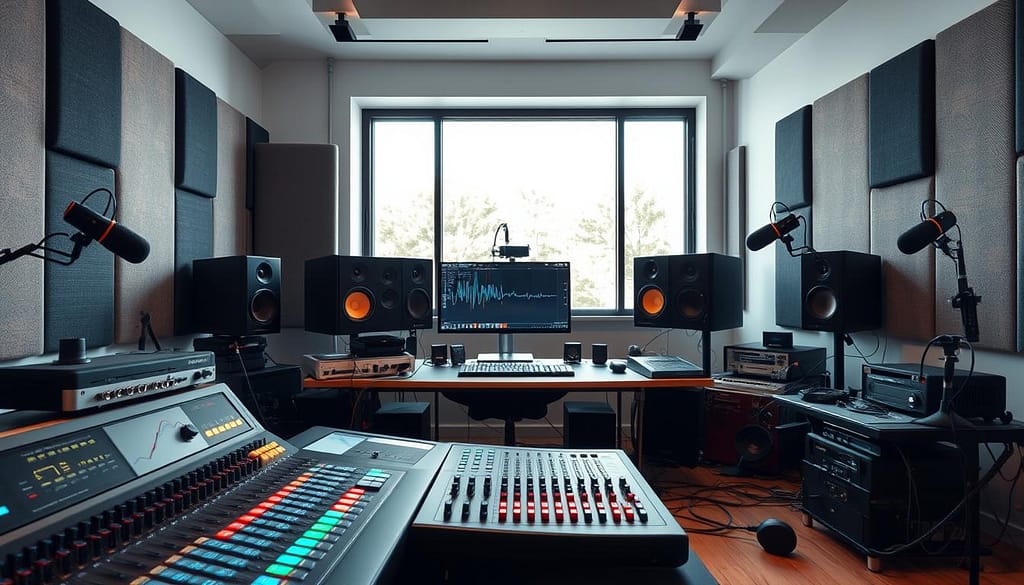
Just like a Foley artist in a studio, a competitive gamer must learn to dissect the precise audio signature of a footstep. In professional sound design, creators use a specially built review room. The goal is a flat frequency response, between 50 and 400 Hertz. This neutral environment strips away room acoustics. It lets the artist hear the pure sound, free from echo or bass boost.
Why does this technical detail matter for gaming? Your headphones and game settings are your “review room.” If your audio is muddy or has too much bass, you miss subtle audio cues. You might not hear the faint scuff of a boot on metal. Or you could mistake a distant run for a close walk. Training your ear starts with understanding the two pillars of footstep intel: radius and surface.
Understanding the Footstep Radius
The footstep radius is the maximum distance a movement sound can be heard. It’s not a fixed number. It changes based on your character’s speed and posture.
- Walk: The quietest and shortest radius. It’s for precise, stealthy positioning.
- Run: The loudest and longest radius. It broadcasts your location but gets you there fast.
- Crouch: A drastically reduced radius. This is your primary stealth movement.
Knowing these radii lets you gauge threat distance. A running sound that is faint is likely far away. A walking sound that is clear and bright means immediate danger.
Decoding Surface Acoustic Signatures
Every surface has a unique acoustic signature. This is its tonal quality or timbre. Concrete sounds different from grass. Metal rings differently than wood. A Foley artist listens for these nuances to pick the perfect sound effect. You must learn them to identify an enemy’s location.
For example, low-frequency rumbles can mean someone is on thick carpet or dirt. High-frequency clicks and clacks signal metal grates or wooden floors. The game engine uses these signatures. Your job is to memorize them.
The table below breaks down common surfaces, their key audio characteristics, and how they typically affect the audible radius of footsteps.
| Surface Type | Key Audio Cues & Timbre | Radius Impact |
|---|---|---|
| Concrete/Stone | Sharp, high-frequency scrape or tap. Can have a slight echo or reverb tail. | Medium to Long. Sound carries well on hard surfaces. |
| Metal | Distinctive metallic ring, ping, or hollow clang. Often has a sustained resonance. | Long. The resonant quality makes these footsteps travel far. |
| Grass/Dirt | Muffled, soft thud or rustle. Dominated by low to mid frequencies with little high-end. | Short. Soft surfaces absorb and dampen sound quickly. |
| Wood | Hollow knock or creak. A mix of low thump and mid-frequency squeak. | Medium. Sound is clear but doesn’t resonate like metal. |
| Water/Puddles | Sharp splash or wet *slosh*. Very bright and transient sound. | Medium to Long. The splash effect is often very distinct and audible. |
Use this table as a mental checklist. When you hear a footstep, ask: Was it a sharp tap or a dull thud? Did it ring or was it muffled? This quick analysis tells you the surface. Combine that with your estimate of the radius (loudness). You now know what they are walking on and a rough idea of how far.
Mastering these audio cues turns random noise into a tactical map. It is the difference between reacting to a surprise and orchestrating one. Start by playing a few matches focused only on sound. Ignore the visuals. Listen for the radii and signatures. You are training your own internal Foley studio, and the intel you gain will be decisive.
Volume/Compressor Settings That Help
Your game’s audio mix is like a live concert. A monitor engineer makes sure the performer hears every detail. Your sound settings should do the same for you. This approach helps you hear every important sound.
In-game audio is a big challenge. The volume difference between quiet footsteps and loud sniper shots is huge. If you turn up the volume to hear quiet sounds, loud ones become too loud. If you keep it low, you might miss important sounds.

The goal is not just to turn up the volume. It’s to make everything clear. Like a monitor engineer, you need to balance your game’s audio. The most important sounds, like footsteps and reloads, are in the mid-range frequencies.
Understanding compression is key. It reduces loud sounds and boosts quiet ones. This makes the audio more consistent.
The benefit is huge: you can hear important sounds without being overwhelmed. It reduces fatigue during long gaming sessions. Many games have a “Night Mode” or “Compression” preset for this.
For competitive play, try these audio setting strategies:
- Dynamic Range: Use “Low” or “Compressed” presets. They give you consistent audio information.
- Volume Normalization: Enable it if your game or sound driver has it. It manages peak volumes.
- EQ Tweaks: Gently boost the mid-range (around 800Hz-2kHz). Be careful not to make the sound muddy.
- Master Volume: Set it so loud sounds are just below uncomfortable. Your ears will adapt to pick up quiet details.
Your hardware affects your approach. Headphone users should disable surround sound virtualization. This is because most games use stereo mixing for precise cues. Speaker users need a balanced setup and may benefit from compression to improve sound quality.
Fine-tuning your audio configuration turns noise into a tactical advantage. It helps you recognize useful audio cues consistently. Experiment with these principles in your game’s menu or sound card software. The right mix helps you understand what the enemy is doing.
Audio Baits & Sound Discipline
Being an audio expert means using sound to trick and control. It’s about making your enemy react to what you want them to hear. You’re the master of audio cues.
Imagine a radio drama. Great sound design is not just random noise. It’s a story told through sound. In games, your sounds should tell a false story.
Audio Baits: The Art of Deception
An audio bait is a sound you make to trick your opponent. You want them to react, like peeking or using a utility. Good baits are believable and well-timed.
- Fake Reloads: Tap the reload key near a corner, then cancel it. An eager opponent might swing, expecting you to be vulnerable.
- Misdirection Throws: Toss a grenade or ability in one direction, then push from another. The loud sound covers your real movement.
- Controlled Footsteps: Walk loudly toward a fake plant site or a dead-end, then stop and hold an off-angle.
These sounds create a predictable sonic world for your enemy. But you control it. You’re not just making noise; you’re writing a script they will follow.
Sound Discipline: The Power of Silence
Sound discipline is your defense. It’s about making less noise. This creates pressure.
When you’re silent, you give your enemy no sound information. This makes them anxious and unsure. They might guess your position or waste utility to find you.
Key practices for sound discipline include:
- Crouch-Walking: For slow, silent repositioning when absolute stealth is needed.
- Timing Your Actions: Move, reload, or swap weapons during loud environmental events—like a teammate’s gunfight, a grenade explosion, or map-specific noise.
- Controlled Peeking: Use slow walk or crouch to avoid giving away your shoulder-peek sound.
This silence makes your sounds more impactful and surprising.
Putting It All Together
The best players use both baits and discipline. Every noise is a choice. You either use sound to trick (a bait) or save it to hide (discipline).
The table below contrasts these two core strategic approaches:
| Tactic | Goal | Key Principle | Example |
|---|---|---|---|
| Audio Bait | Deceive & Lure | Intentional, planned sound to create a false narrative. | Fake reload to bait a swing. |
| Sound Discipline | Conceal & Control | Strategic silence to create uncertainty and pressure. | Crouch-walking during a lull to flank silently. |
Mastering this balance makes audio a tool for psychological warfare. You control the match’s story, one sound or silence at a time. Think about what you want your enemy to hear.
Solo & Team Drills for Sound Localization
Knowing audio theory is one thing. Applying it under pressure is another. Structured practice turns your knowledge into instinct.
Start with solo drills. Load a custom map or use practice modes. Your goal is to isolate sounds. Close your eyes and listen. Focus on identifying the exact direction and elevation of a footstep or gun reload.
Adjust your personal sound settings for clarity. Enable HRTF to better judge if a sound comes from above or below.
Think like a monitor engineer. Put yourself in the performer’s position. Listen critically to how the virtual environment colors each sound. Is the footstep on wood, metal, or concrete?
Radio drama producers treat a character as a collection of sounds—footsteps, clothing rustle, breathing. Practice dissecting this complex soundscape in your game.
Team drills build on this. Coordinate with your squad in a quiet custom lobby. One player makes noise while others, with eyes closed, pinpoint the location.
The caller must move beyond “I hear someone.” Effective audio callouts sound like, “Footsteps on metal, west, second level, moving south.”
This precision turns individual awareness into a coordinated weapon. Your team learns to trust and act on sound intelligence. You stop just hearing the game. You start winning it.